
"Are nonstick pans safe?" is one of the most-Googled kitchen questions, and the honest answer is: modern ones are considered safe for normal cooking — with a couple of sensible rules. A lot of the fear comes from older headlines about a chemical (PFOA) that hasn't been used in years. Here's a clear, non-alarmist rundown of what the science actually says, what to avoid, and the coating-free options if you'd rather not think about it at all.
What you need to know
The scary chemical (PFOA) is already gone
Most nonstick fear traces back to PFOA, a processing chemical once used to make Teflon. It was phased out of U.S. cookware manufacturing by around 2013–2015 and is no longer used. Pans you buy today are made without PFOA, which removes the specific concern most of those old articles were about.
The real rule is don't overheat an empty pan
The nonstick coating itself (PTFE) is stable at normal cooking temperatures, but it can begin to break down and release fumes above roughly 500°F (260°C) — temperatures you mostly hit by preheating an empty pan on high. Keep nonstick to low and medium heat, never leave an empty pan on a hot burner, and you stay well clear of that threshold. (Those fumes are also why overheated nonstick is dangerous to pet birds.)
Replace pans once the coating is scratched or flaking
A scratched or peeling coating is the clearest sign to retire a pan. Eating a tiny flake of PTFE isn't considered toxic (it passes through), but a damaged coating no longer performs and signals the pan is past its life. Use wood, silicone, or nylon utensils, skip the dishwasher, and a nonstick pan will last years longer.
"PFAS-free" ceramic skips the chemistry entirely
If you'd rather avoid fluoropolymers altogether, mineral-based ceramic coatings (like Blue Diamond or other PFAS-free pans) contain no PTFE or PFAS. They're a reasonable middle ground — easy release without the coating debate — though ceramic tends to lose its slickness faster than traditional nonstick, so treat it gently.
Stainless and cast iron have no coating at all
For high-heat searing or total peace of mind, bare cookware sidesteps the question completely. A clad-stainless pan and a well-seasoned cast iron skillet have nothing to wear off or overheat, and both last decades. Many cooks keep one good nonstick pan for eggs and rely on stainless or cast iron for everything else.
Recommended Gear
The gear we'd reach for. Prices shown on Amazon at click-through.
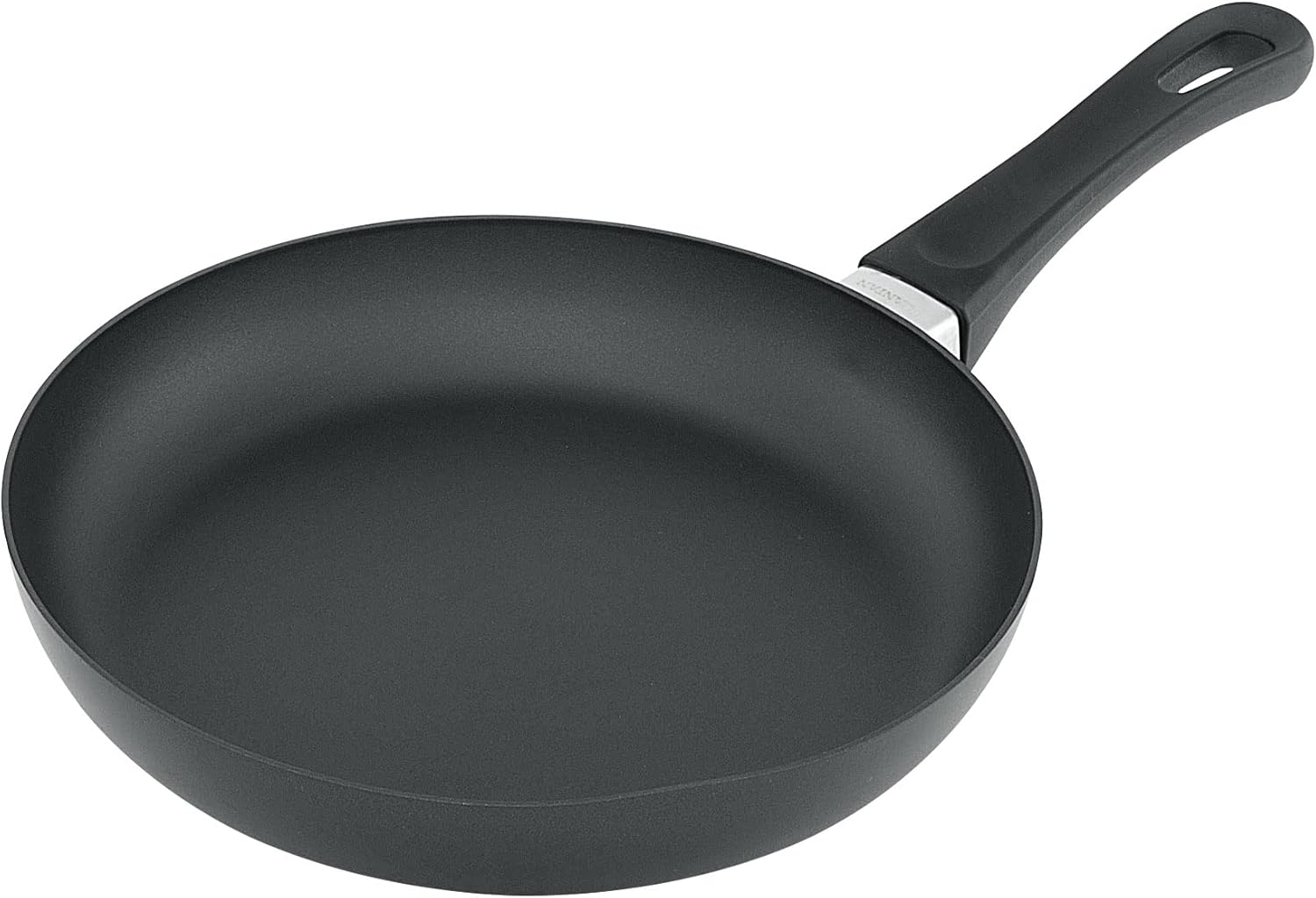
Scanpan Classic 10.25" Nonstick Fry Pan (PFOA-Free)
premium tier
A Danish-made nonstick that's PFOA-free and metal-utensil safe, with a ceramic-titanium surface tougher than standard coatings.
Check Price on Amazon →
Blue Diamond 10" Ceramic Nonstick Fry Pan (PFAS-Free)
budget-friendly
Diamond-infused ceramic that's PFAS- and PTFE-free — an affordable way to skip the fluoropolymer question entirely.
Check Price on Amazon →Frequently Asked Questions
Is Teflon toxic?
At normal cooking temperatures, PTFE (the technical name for Teflon-style coatings) is considered inert and safe — it isn't absorbed by the body. The historical concern was PFOA, a separate chemical used in manufacturing that has been phased out. The main caution today is not to overheat an empty nonstick pan, which can cause the coating to break down.
At what temperature do nonstick pans become unsafe?
PTFE coatings start to degrade and can release fumes above roughly 500°F (260°C). You rarely reach that cooking with food in the pan, but you can by preheating an empty pan on high heat. Sticking to low and medium heat keeps you comfortably within the safe range.
Should I throw away a scratched nonstick pan?
A few light marks aren't an emergency, but once the coating is visibly scratched, peeling, or flaking, it's time to replace it — not because a stray flake is poisonous (it isn't, it passes through), but because the pan no longer works well and the coating is failing. Using soft utensils and hand-washing prevents most scratching.
Is ceramic cookware safer than nonstick?
Ceramic (mineral) coatings are PFAS- and PTFE-free, so they avoid the fluoropolymer question entirely, which is why many people prefer them. They're considered safe and perform well, but the coating typically wears out faster than traditional nonstick. Bare stainless steel and cast iron have no coating at all if you want to remove the question completely.
Do I need to replace all my nonstick pans?
Not if they're in good shape. Pans bought in the last decade are PFOA-free, and intact coatings are safe for everyday cooking. Replace only the ones that are scratched, peeling, or warped. If you're buying new and want to avoid coatings, look at PFAS-free ceramic, stainless, or cast iron.
Are PFOA-free non-stick pans safe?
Yes — PFOA (the dangerous chemical in older Teflon) was phased out by 2015. Modern PTFE-coated non-stick is FDA-approved as safe at normal cooking temperatures (under ~500°F). Ceramic non-stick (PFAS-free) is the alternative if you want to avoid PTFE entirely.
What is the safest non-stick coating in 2026?
PFAS-free ceramic coatings (Caraway, GreenPan, Our Place) — they contain no PFOA, PFOS, or PTFE. The trade-off: shorter useful life (1-3 years) vs PTFE (3-5 years). For maximum safety with zero compromise, bare stainless or cast iron is the truly inert option.
Want to dig deeper? See our guides to Best Non-Toxic Cookware (2026), Best Nonstick Pans (2026), and Best Nonstick Cookware Set (2026).