

Quick Answer
For most home cooks, the All-Clad D3 Stainless Steel 10-Piece Cookware Set is the better pick — The stainless case: nothing to wear out, it sears and browns beautifully, it's oven-safe to 600°F, and it lasts decades. The T-fal Initiatives Nonstick Cookware Set, 18-Piece wins on value and is the right call if budget is the deciding factor.
It is the first real fork in the road when you buy a cookware set: stainless steel or nonstick? They are not just different finishes — they are different philosophies. Stainless is the durable, do-anything workhorse that lasts decades but asks you to learn it. Nonstick is the easy, forgiving option that makes eggs effortless but wears out and needs replacing. There is also a third path — PFAS-free ceramic — that splits the difference. We break down how the two stack up on durability, performance, health, and cost, using a representative set from each camp, so you can pick with confidence.
How We Picked These
For this stainless vs nonstick cookware set comparison, we applied the framework laid out in our Editorial Policy: we evaluate materials and construction first, then weight long-term durability heavily — six-month and one-year owner-review patterns matter more than first-week impressions. We hold each candidate to the same criteria (material quality, real-world performance, warranty terms and how the manufacturer actually honors them, and value at each price tier), then note where one option clearly wins, where the difference is marginal, and where the cheaper option is good enough for most people.
1.: All-Clad D3 Stainless Steel 10-Piece Cookware Set
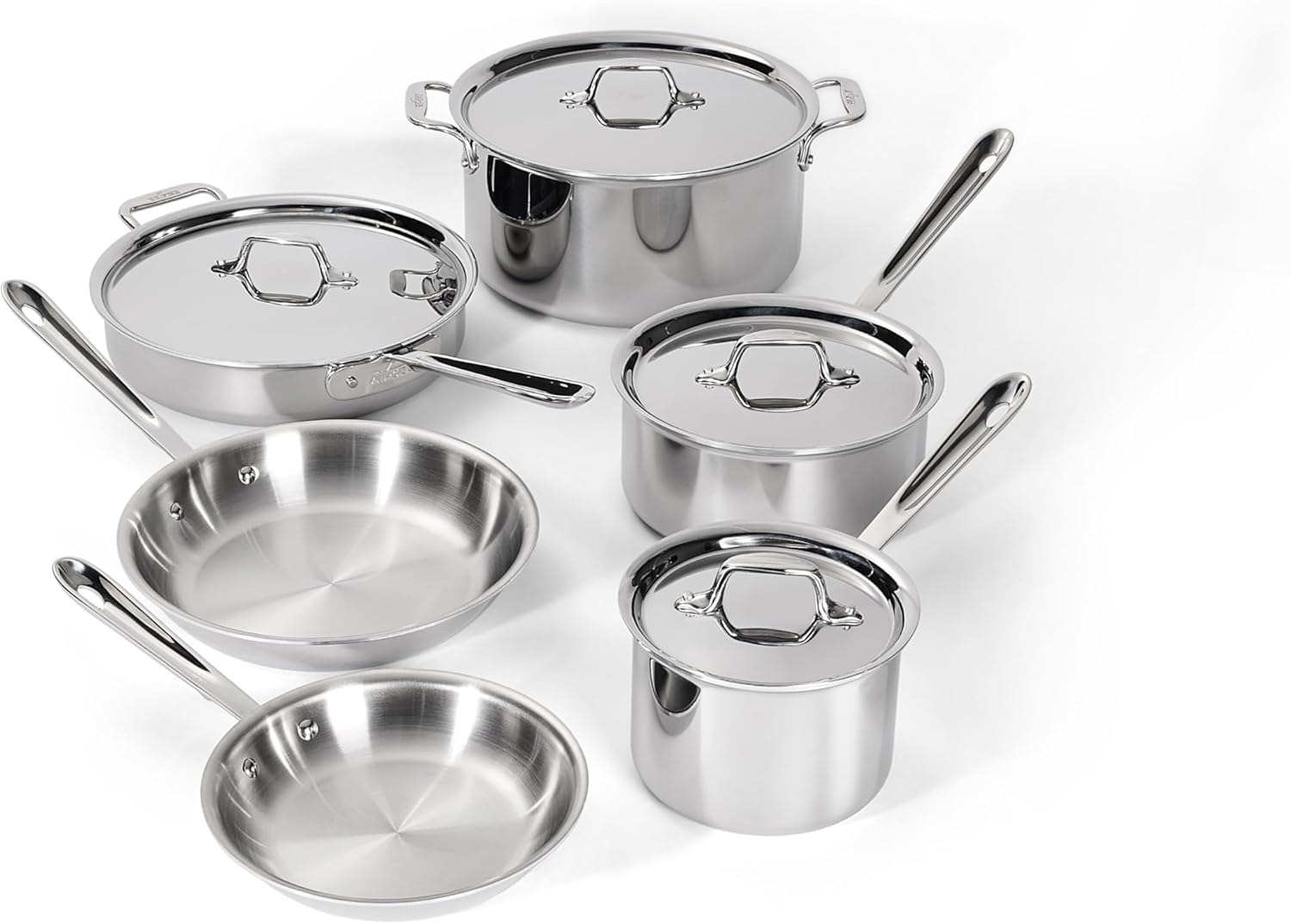
All-Clad D3 Stainless Steel 10-Piece Cookware Set
All-Clad
- No coating to degrade — effectively a permanent set
- Superior browning, fond development, and high-heat searing
- Oven-safe to 600°F and metal-utensil-safe
- Higher up-front cost, but the lowest cost-per-year
Pros
- Made-in-USA fully-clad tri-ply heats evenly to the rim
- Oven- and broiler-safe to 600°F; induction-ready
- Limited lifetime warranty — a true buy-once set
Watch-outs
- Premium price
- Bare stainless needs preheating or food can stick
2.: T-fal Initiatives Nonstick Cookware Set, 18-Piece

T-fal Initiatives Nonstick Cookware Set, 18-Piece
T-fal
- Effortless food release with little to no oil
- Easiest cleanup and the gentlest learning curve
- 18 pieces at an entry-level price
- Coating wears out in a few years — plan to replace
Pros
- 18 pieces — outfits a whole kitchen at once
- Thermo-Spot indicator shows when it's preheated
- Very affordable and dishwasher-safe
Watch-outs
- Nonstick coating wears out in a few years
- Only oven-safe to 350°F
Alternative Pick: Caraway Non-Stick Ceramic Cookware Set (12-Piece)

Caraway Non-Stick Ceramic Cookware Set (12-Piece)
Caraway
- Nonstick convenience that's PFAS- and PFOA-free
- Higher heat tolerance than traditional nonstick (to 550°F)
- Coordinated 12-piece set with magnetic storage
- Needs gentler care to preserve the coating
Pros
- PFAS-, PFOA-, lead-, and cadmium-free ceramic coating
- Includes magnetic racks and a lid holder for storage
- Attractive colors; oven-safe to 550°F
Watch-outs
- Ceramic nonstick wears out faster than stainless or PTFE
- Premium price for a coating that isn't permanent
The Comparison Table
| Product | Brand | Role | Key spec |
|---|---|---|---|
| All-Clad | All-Clad | Contender A | No coating to degrade — effectively a permanent set |
| T-fal | T-fal | Contender B | Effortless food release with little to no oil |
| Caraway | Caraway | Wildcard | Nonstick convenience that's PFAS- and PFOA-free |
The Verdict
Get a stainless set (like the All-Clad D3) if you want it to last decades, you sear and brown a lot, and you do not mind a learning curve. Stainless has no coating to wear out, develops the fond that makes pan sauces, and is oven-safe to high temperatures. It costs more up front but the least over its lifetime.
Get a nonstick set (like the T-fal Initiatives) if you cook a lot of eggs and delicate foods, you want the easiest cleanup, and you would rather spend less now. A full 18-piece nonstick set costs a fraction of clad stainless — just budget to replace it every few years as the coating wears.
Consider ceramic (like Caraway) if you want nonstick ease without the PFAS chemistry. It releases food well, tolerates somewhat higher heat than traditional nonstick, and comes in attractive sets — but it still needs gentle care and will not last like stainless.
The honest answer for most kitchens is 'both.' The classic setup is a clad-stainless set for everyday cooking, browning, and oven work, plus one good nonstick or ceramic skillet reserved for eggs and fish. You get durability where it counts and easy release where you need it.
Match the choice to your cooktop and habits. Induction needs magnetic bases (stainless qualifies; check nonstick sets carefully). If you cook on high heat or use metal utensils by habit, lean stainless — nonstick punishes both.
Buyer Scenario Decision Matrix
Stop comparing specs. Start with what you're actually doing, then the right product is obvious:
| Your Situation | Buy This | Skip This | Why |
|---|---|---|---|
| Most people — daily use, no compromises | All-Clad D3 Stainless Steel 10-Piece Cookware Set | Premium-only sets you won't grow into | No coating to degrade — effectively a permanent set |
| Budget-conscious or first-time buyer | T-fal Initiatives Nonstick Cookware Set, 18-Piece | Premium upgrade you may not need yet | Effortless food release with little to no oil |
| Heavy daily use, splurge, or buy-once-keep-forever | Caraway Non-Stick Ceramic Cookware Set (12-Piece) | Cheaper sets — you'll outgrow them | Nonstick convenience that's PFAS- and PFOA-free |
Bottom Line: Which Should You Buy?
For most people: the All-Clad D3 Stainless Steel 10-Piece Cookware Set. The stainless case: nothing to wear out, it sears and browns beautifully, it's oven-safe to 600°F, and it lasts decades.
On a budget: the T-fal Initiatives Nonstick Cookware Set, 18-Piece. The nonstick case: eggs slide right out, cleanup is a wipe, and a full 18-piece set costs a fraction of clad stainless.
Worth the splurge: the Caraway Non-Stick Ceramic Cookware Set (12-Piece). Can't choose? PFAS-free ceramic is the middle path: nonstick ease without the fluoropolymer chemistry.
Ready to buy?
Jump straight to our top picks on Amazon — prices shown at click-through.
Frequently Asked Questions
Is stainless steel or nonstick cookware better?
Neither is universally better — they suit different jobs. Stainless is more durable, sears better, and lasts decades; nonstick is easier for eggs and cleanup but wears out. The most practical answer for most kitchens is a stainless set plus one nonstick skillet.
Is nonstick or stainless healthier?
Bare stainless has no coating at all, so there is nothing to wear into food, which is why some people prefer it. Modern nonstick is PFOA-free and considered safe for normal cooking as long as you do not overheat empty pans. PFAS-free ceramic is a middle option for the coating-averse.
Should my first cookware set be stainless or nonstick?
If budget allows, a clad-stainless set is the better long-term first purchase because it lasts and does everything. If money is tight, a nonstick set gets you cooking for much less today — just know you will likely replace it in a few years.
Can you sear meat in nonstick?
Not really — nonstick coatings should not be used at the high heat a good sear requires, and they do not build the browned fond that makes pan sauces. Searing and browning are exactly where stainless (or cast iron) earns its keep.
Do I need a whole set of each?
No. The efficient setup is one full clad-stainless set for everyday and high-heat cooking, plus a single nonstick or ceramic skillet for eggs and delicate foods. Buying two complete sets is usually overkill.
What is the top-rated pick for stainless vs nonstick cookware set?
The All-Clad D3 Stainless Steel 10-Piece Cookware Set is our top-rated choice — The stainless case: nothing to wear out, it sears and browns beautifully, it's oven-safe to 600°F, and it lasts decades. Choose the T-fal Initiatives Nonstick Cookware Set, 18-Piece if the nonstick case: eggs slide right out, cleanup is a wipe, and a full 18-piece set costs a fraction of clad stainless.
Should I buy stainless or non-stick cookware first?
Buy both — they do different jobs. A stainless pan is for searing, browning, and any high-heat work; a non-stick is for eggs, fish, and pancakes. A 'first set' that has one of each is more useful than ten matching pieces of either alone.
Can stainless replace non-stick if I learn proper technique?
Almost — properly preheated stainless will release most foods, including eggs (the 'Mercury ball test'). But for ultra-delicate cooking (omelets, crepes, flaky fish) non-stick is still easier. Most experienced cooks keep both.
Want to dig deeper? See our guides to Best Cookware Sets (2026), Best Stainless Steel Cookware Set (2026), and Best Nonstick Cookware Set (2026).