

Quick Answer
For most home cooks, the Tramontina Tri-Ply Clad Stainless Steel 14-Piece Cookware Set is the better pick — The stainless case: a fully-clad, no-coating set that sears and browns, handles metal utensils and the oven, and lasts for decades. The Calphalon Ceramic Nonstick 12-Piece Cookware Set wins on value and is the right call if budget is the deciding factor.
Stainless steel and ceramic are the two honest answers to “what should I cook in?” Stainless lasts for decades and sears beautifully but asks you to learn it; ceramic is effortlessly nonstick and PFAS-free but wears out and has to be replaced. Neither is simply “better” — they're built for different priorities. Here's how they actually compare, and which one fits the way you cook.
How We Picked These
For this stainless steel vs ceramic cookware comparison, we applied the framework laid out in our Editorial Policy: we evaluate materials and construction first, then weight long-term durability heavily — six-month and one-year owner-review patterns matter more than first-week impressions. We hold each candidate to the same criteria (material quality, real-world performance, warranty terms and how the manufacturer actually honors them, and value at each price tier), then note where one option clearly wins, where the difference is marginal, and where the cheaper option is good enough for most people.
1.: Tramontina Tri-Ply Clad Stainless Steel 14-Piece Cookware Set

Tramontina Tri-Ply Clad Stainless Steel 14-Piece Cookware Set
Tramontina
- Tri-ply clad — aluminum core bonded through the whole pan
- No coating to wear out — effectively permanent
- Induction-ready, NSF-certified, oven- and dishwasher-safe
- Sears, browns, and builds fond for pan sauces
Pros
- Nothing to degrade — the lowest cost-per-year here
- Fully-clad heats evenly for searing and browning
- Oven-, dishwasher-, and metal-utensil-safe; induction-ready
Watch-outs
- Food sticks if you don't preheat and use enough fat
- Steeper learning curve than nonstick
2.: Calphalon Ceramic Nonstick 12-Piece Cookware Set
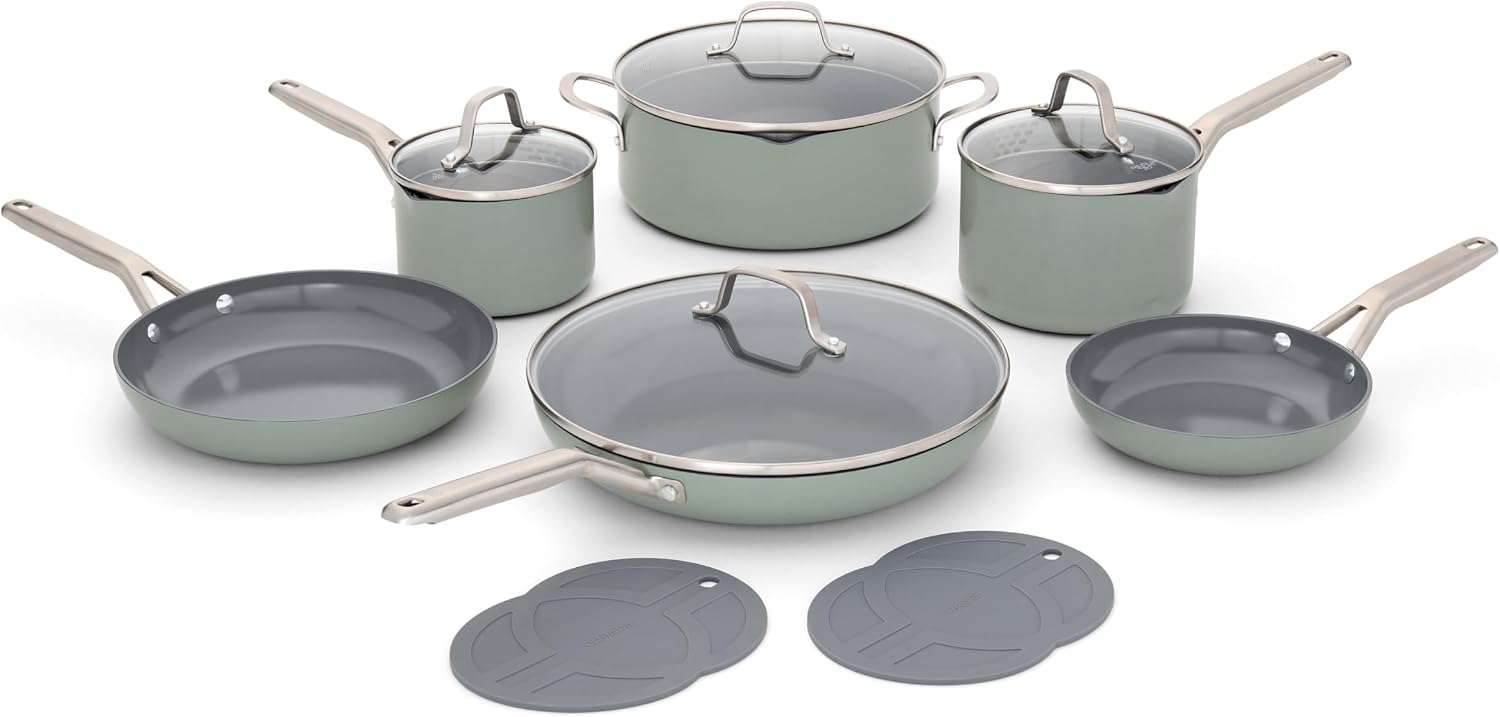
Calphalon Ceramic Nonstick 12-Piece Cookware Set
Calphalon
- PFAS-free ceramic nonstick — effortless release
- Wipe-clean cleanup
- Lighter and more forgiving to cook on
- 12-piece set from a recognized brand
Pros
- Effortless food release with little oil
- Easiest cleanup and gentlest learning curve
- PFAS-free coating — no fluoropolymer chemistry
Watch-outs
- Coating wears out in a few years and isn't repairable
- Not for high-heat searing or metal utensils
The Comparison Table
| Product | Brand | Role | Key spec |
|---|---|---|---|
| Tramontina | Tramontina | Contender A | Tri-ply clad — aluminum core bonded through the whole pan |
| Calphalon | Calphalon | Contender B | PFAS-free ceramic nonstick — effortless release |
The Verdict
Durability and cost-per-year. Stainless has no coating to fail — a good clad set is effectively a buy-once purchase you'll keep for 20-plus years, so even at a higher sticker price it's usually the lowest cost per year of use. Ceramic's nonstick surface is consumable and fades in roughly one to three years, after which the pan still works but no longer releases. If “buy it once” matters most, that points to stainless.
Performance: searing versus release. Stainless browns meat, builds fond for pan sauces, and takes high heat and the broiler — but food sticks if you don't preheat and use enough fat. Ceramic releases eggs and fish with almost no oil and wipes clean, which makes it the easier daily driver for low-fat cooking and quick breakfasts, but it can't sear like bare steel and shouldn't be pushed to high heat.
Safety and maintenance. Both are safe choices: bare stainless is inert with nothing to flake, and reputable ceramic coatings are PFAS-, PFOA-, and PTFE-free. The difference is upkeep — stainless tolerates metal utensils, scrubbing, and the dishwasher, while ceramic needs gentle heat, soft utensils, no aerosol sprays, and hand-washing to last. Many cooks end up owning both: a stainless set for searing and sauces, plus one or two ceramic pans for eggs.
Buyer Scenario Decision Matrix
Stop comparing specs. Start with what you're actually doing, then the right product is obvious:
| Your Situation | Buy This | Skip This | Why |
|---|---|---|---|
| Most people — daily use, no compromises | Tramontina Tri-Ply Clad Stainless Steel 14-Piece Cookware Set | Premium-only sets you won't grow into | Tri-ply clad — aluminum core bonded through the whole pan |
| Budget-conscious or first-time buyer | Calphalon Ceramic Nonstick 12-Piece Cookware Set | Premium upgrade you may not need yet | PFAS-free ceramic nonstick — effortless release |
Bottom Line: Which Should You Buy?
For most people: the Tramontina Tri-Ply Clad Stainless Steel 14-Piece Cookware Set. The stainless case: a fully-clad, no-coating set that sears and browns, handles metal utensils and the oven, and lasts for decades.
On a budget: the Calphalon Ceramic Nonstick 12-Piece Cookware Set. The ceramic case: a PFAS-free nonstick set where eggs slide out and cleanup is a wipe — easiest to live with, but the coating is consumable.
Ready to buy?
Jump straight to our top picks on Amazon — prices shown at click-through.
Frequently Asked Questions
What is the top-rated pick for stainless steel vs ceramic cookware?
The Tramontina Tri-Ply Clad Stainless Steel 14-Piece Cookware Set is our top-rated choice — The stainless case: a fully-clad, no-coating set that sears and browns, handles metal utensils and the oven, and lasts for decades. Choose the Calphalon Ceramic Nonstick 12-Piece Cookware Set if the ceramic case: a PFAS-free nonstick set where eggs slide out and cleanup is a wipe — easiest to live with, but the coating is consumable.
Is stainless steel or ceramic cookware better?
Stainless lasts decades, sears, and is the lowest cost-per-year, but food sticks without technique. Ceramic is effortlessly nonstick and PFAS-free but wears out in a few years. Choose stainless for buy-once durability and searing; choose ceramic for easy, low-fat cooking and cleanup. Many cooks own both.
Is ceramic or stainless steel safer?
Both are safe. Bare stainless is inert with no coating to flake, and reputable ceramic is PFAS-, PFOA-, and PTFE-free. The practical difference is upkeep, not safety — stainless tolerates metal utensils and the dishwasher; ceramic needs gentler handling.
Want to dig deeper? See our guides to Best Ceramic Cookware (2026), Best Stainless Steel Cookware Set (2026), and Best Non-Toxic Cookware (2026).